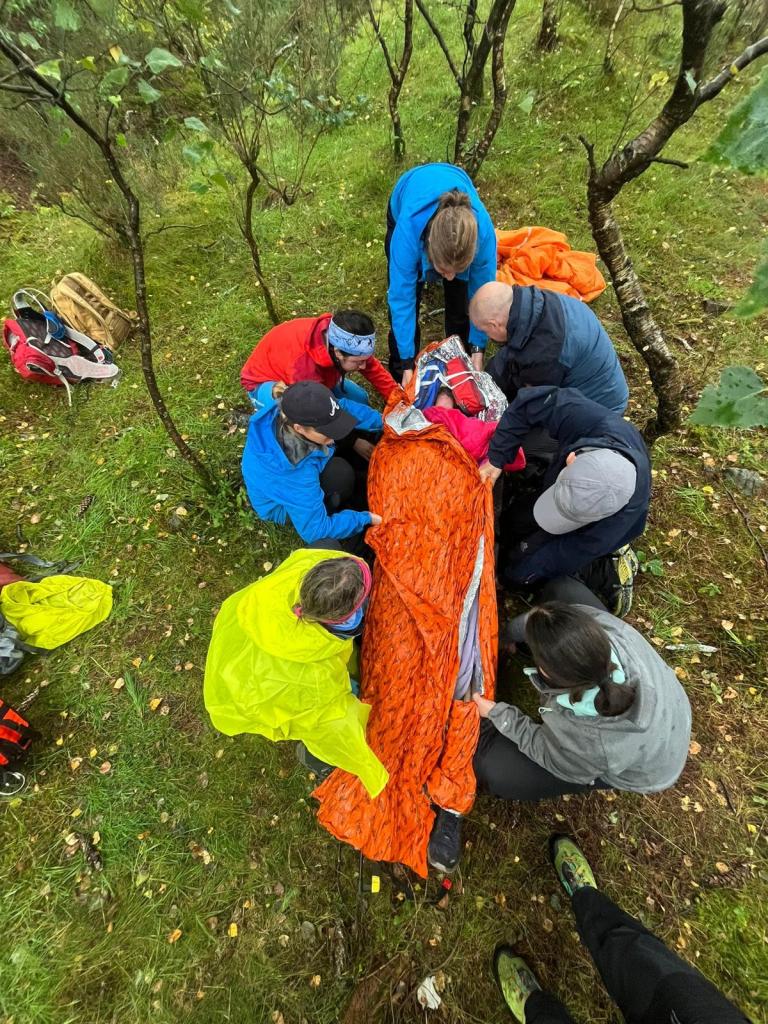
I find my patient propped up against the fallen branch of a tree, pine needles sprinkled over his jacket, and pinecones scattered around him on the ground. A chain saw gently hums to one side and a red stained trouser leg reveals the urgency of the situation. My colleague pushes a gauze bandage deep into a thigh wound, as I tighten a torniquet around the his thigh. A few frantic minutes pass, filled with “good enough” assessment and treatment – oxygen is applied, an IV fixed and tranexamic acid infused.
Then, thankfully, a call of “ok lets stop there” and the exercise is over. I take a breath and shiver even though the frenetic activity has more than warmed me against the fading breeze of a now-passed storm moving across the Scottish Highlands.
It’s a different kind of medicine. A world away from the day job down in nice suburban Surrey. We are a team of 6, within a team of 24, all here to learn how to move out of our comfort zone – into the realm of remote pre-hospital emergency care. It’s been exhausting. Over the course of a weekend, we’ve had to deal with more critically ill patients than I hope to meet in an occupational lifetime. Desperate scenario after desperate scenario – drownings, cardiac arrests, falls from height, road traffic collisions, hapless pedestrians, horse riders and mountain bikers. Staying at home suddenly seems much safer.
We are, though, a team – the six of us. From different backgrounds with different skills and experiences, we learnt to compliment (and complement) each other. Getting it wrong was ok in this safe space – and with 20 serious incident de-briefs a day – the collective learning was progressive, positive and importantly blame-free. We’re not going to give vasopressives in trauma, we’ve tried that, and we know it doesn’t work. We’re not going to keep defibrillating our hypothermic patients, we know they need warming up. We also know who our pickier instructors are – they’re all the same at a technical level, but we know when we’ll be pulled up on a word, or even a gesture. We learnt that together.
We’re training for the stressful– its challenging to put yourself in an isolated situation, miles (or hours) from the nearest help – especially when the storms return and the trees start to fall again. A world away from Surrey – these colleagues work on islands, or remote peninsulas, manning community hospitals with local emergency units, without the onsite support of specialists and intensive care units. They do so with passion – both for their job, but also their unique environment. These are special places with astonishing scenery and tight knit communities, with a true social bond.
It’s a different kind of pressure back home. A different kind of intensity. We’ve just moved up another step in the digital transformation journey for General Practice in England. Contractually the ask, as of 1st October, is now for online consultation forms to be on “all day” – that is for the duration of core contracted hours of GP – 8am until 6.30pm. The benefits are clear – the ability to distil patient concerns concisely and conveniently, for clinicians inside the practice to assess and prioritise. Contrary to popular concern I also don’t see a natural demographic disenfranchisement – my Dad at 89 is a great fan of the system! We do of course need to be careful, and ensure we retain realistic “channel agnostic” access – walk-in, phone-in or access online – the outcome for the patient should be the same.
We have unintended consequences though, or the threat of unintended consequences; The first is the risk of short-cutting careful methodical patient care, in favour of poorly considered investigation or action. This is a bit of a philosophical one for me, and it stems from reflections on what is the true skill set of GP. Some years ago I spent a little time as a “GP in A&E”, and experienced the well-recognised phenomenon of a rapid change in my pragmatic and “GP” approach into a “hospital doctor” philosophy – its far easier to make a careful judgment that a patient has non-cardiac chest pain in a GP setting without investigation, than it is to do the same in a hospital setting when the near-patient Troponin-T test to exclude heart disease is immediately to hand.
The risk of improving (online) access for patients risks a similar move to increased investigation – in the name of efficiency, but without the face-to-face opportunity to holistically assess the individual. It’s very easy (and efficient – and I do it) to arrange a chest xray for a patient on the basis of a history given through an online form – before the patient has seen the GP – so that the patient can be fully assessed later with all the relevant information to hand. However get the balance wrong, and patients can end up being “over-medicalised” with low value investigations – and then treatments, when the root cause was psychosocial unrest. Not surprisingly that unrest then reappears in a different manner at a later date.
Continuity of care is the second, closely related, issue. As we broaden access, it really is a challenge to optimise continuity of care. It can be done, but it requires the desire to do so, practice-awareness and a team approach – all things easily lost when a practice is under pressure. The tech doesn’t (yet) help here either. It maybe we will see AI tools finely tuned to detect the subtleties of patients in need of continuity of care, and tools which can highlight when a patient is “at risk of over-investigation” – but I’ve not seen much evidence of that. I remain very proud of my work with NICE on the Multi-Morbidity Guideline – but almost a decade later, this remains an area of great need.
Improving access is the right thing to do – but we need to remember the key quality of General Practice – and our core skill – caring for the complex in a low interventional setting.
Which takes me back to my friend with the chain saw lying under a tree in the Scottish Highlands. A truly complex case in a low interventional setting – enough to scare most GPs away from volunteering at their local tree cutting competition. But in a funny way a situation less challenging than our day job, which is to create amazing access for our patients, whilst still valuing them as individuals and offering them the personalised care they deserve and need.
If that’s what you’re striving to do this week in your practice – well done and keep up the good work.
 The Deer Doctor